
Wednesday, May 20, 2009
Now, there is a most effective and long lasting Marketing Strategy to get noticed and attract millions of search engine visitors.
The choice of your Domain Name is the most important Marketing Strategy you’ll ever make to help you to rank higher on thousands of Search Engines and attract millions of visitors each year.
The truth is, websites with Generic Keywords in their domain name WILL list higher (in the first 20 listings on top Search Engines) than the most optimized websites and is easier to find on top Search Engines.
Before purchasing a domain name, there are many things to consider. In order to be seen by buyers when they are using a search engine to look for a product or service, it is essential that your website be one of the first 20 or so listed. One of the best ways to insure this is to use a GENERIC Domain Name for your website.
For Example:
Using a search engine is very similar to looking up a product or service in the Yellow Pages of your local phone book - under the generic name of the product/service you will find companies that have what you are looking for. Similarly, on the internet
, some search engines list websites by how closely the website name compares to the item being searched for.
If your business name is ABC Corp. and you are in the business of selling ‘Baby Toys’ online. You’ll drive thousand times more targeted traffic if your Domain name includes your “Main Key Word” on it like:
TopBabyToys.com
JustBabyToys.com
CustomBabyToys.com
AmericanBabyToys.com
UltimateBabyToys.com or,
ABCKidsToys.com; Instead of your brand name ABCCORP.COM.
A good generic domain name can put you way ahead of your competition in the search engines, and, can literally be worth many millions of dollars.
In the past, some companies believed that company recognition was the key and were willing to pay a lot of money to obtain this. The internet, however, is changing the way that knowledgeable company executives are attracting buyers.
Unless you are willing to spend hundreds of millions of dollars on advertising, it is much more important to select a generic domain name that identifies the product or services you provide to users on your website.
With a GENERIC domain name and a programmer who understands the importance of generic keys to search engine spiders, your website can be way above your competition on internet search engines.

Below are few of the tips to help you to find the right domain name for your business, that will be a successful choice for you.
1.The extension of domain name should make a notice to the user about your location and target marketplace. If your business targets to local community than you must go to get country specific domains. You will get benefits of such local domains in your search engine results and people in that country will know that they are dealing with local entity. If you would like ti target globally or you are based in US than go for .com domains.
2.Use of keyword in domain names sometimes helps in search engine results
3.Short names are much easier to remember and spell correctly. Using long name, by only one spelling mistake you can lose a potential visitor forever. If it is hard to pronounce than you can't expect users to spread the word.
4.Try to avoid hyphens. If straightforward names are gone than its better to come up with different idea with different name.
5.Go for reputable Domain name registration company. Some of the companies are just the middlemen, they charge much higher fees for the domain name you want. In some of the cases they register using their own information and it becomes difficult for the customer to do anything with that domain.
6.When buying a domain name avoid copyright and trademark infringement. Companies can take legal actions against the website owner, so be careful.
7.Try to buy several different extensions of your domain name, so no one else can violate on your success by registering a similar name.
8.Before you proceed to pay for the domain registration, always do a spell check. Once you registered the domain name, you can't edit it even in your domain control panel.
These tips will help you to register an efficient domain name for your business.
Definition of Domaining
Domaining is basically the business of buying domain names as an investment. When thinking about this business, a good approach is to think of domain names as real estate. Think of them as pieces of virtual internet-land that have some intrinsic value, where the majority of that value stems from their location and from their degree of development. Their "location" is akin to their visibility on the web. Short recognizable names have the best location, and so they are also the most expensive. The buildings on a piece of land are akin to a website developed at a domain name. The website is likely to attract visitors either through it’s content or functionality, and therefore increase the value of the domain name.
Like any mature property business, most of the valuable names have already been snatched up and are only available at a premium. Speculative names are still available, as are names with unproven extensions (.info, .biz, .us, etc.) A big difference in the domain world though is that new names with potential are available all the time, as new phrases and trends become popular, as old domain names expire, and as new technologies emerge.
Monetizing a Domain Name
There are a million way to monetize a domain name if you are willing to develop a website on it, but since this article is about the purest form of domaining, I will only address ways to monetize domain names without developing them.
Reselling Domains - As with any piece of property, your domain may be worth more to someone else than you paid for it. This may be the case if you develop a knack for coming up with brandable names ahead of time (ie. google, digg, myspace, zappos), or if you manage to snap up names related to a developing trend or idea (ie. bird flu, wimax, AJAX). This is a speculative way of making money from domains, but your initial investment of $6-9 per domain won’t break the bank and might create a hefty return. Once you buy a few domain names, list them for sale on websites such as Sedo and DomainState to see if any of them get picked up. Remember, patience is a virtue.
Parking Domains - On the web, targeted traffic is worth money. Targeted traffic are simply visitors interested in a specific topic. If your domain names get traffic (more on this later) you can monetize that traffic by parking your domains with a domain parking service such as Sedo, DomainSponsor or Fabulous. You simply register with the service for free, point your domains to their DNS servers, and voila, you’re done. The service puts up a simple one page website on your domain that has advertiser links and information based on the keywords and category associated with your domain name. When visitors follow those links, you share the revenue generated with the domain parking service.
Finding Domain Names
There are many different strategies for coming up with and researching domain names to buy. There is plenty of (well researched) speculation out there, but there are also many domainers buying names with the intention of creating passive income. For this, the domainers buy domains that receive traffic that can be monetized.
The simplest way that a domain receives traffic without having a website on it is through type-ins. We’ve all been responsible for type-ins before when we went straight to the address bar and typed yahoo.com or money.com or bored.com. Sites such as cellphones.com and business.com get hundreds or thousands of targeted visitors a day through type-ins. Often, people will type their search terms directly into the address bar with .com, hoping to find information of interest. This behavior is characteristic of an internet newbie, but keep in mind that there are more newbies on the internet every day, and as broadband becomes more widely available, this is a trend that is going to continue.
Research time is the biggest investment a domainer makes before buying a name. A great free tool that I use for domain research is Domain All-in-One from DomainState. It allows you to quickly check the availability of domains, as well as look up keywords on Overture and domain popularity via Alexa. Below are a few strategies for picking and finding domain names.
Speculation - If you have a good head for names and can come up with catchy ones that might one day be a company’s next product or brand name, give it a try. Also try to spot upcoming trends and catch phrases, and register names related to them. Names in other languages, and names in other Top Level Domains (TLDs) such as .info, .us, .biz, etc. are also quite open to speculation. Remember though that speculation is just that, and there is no guarantee of a future payoff.
Type-in Traffic - Most obvious keywords and phrases have already been registered, but new ones are coming into the public consciousness all the time. New music trends such as reggaeton, new global scares such as bird flu, and new technologies such as wimax present the early bird with an opportunity to register keywords and phrases that are likely to get more and more type-in traffic. Keep your eyes and ears open and do a little research every day to see what is available.
Typos - Misspellings of popular domains get traffic through type-ins. This includes domains such as gogle.com or yahooo.com, but also less obvious ones such as celphones.com and homelaons.com. These domains can be lucrative because you can park these domains using the right keyword and create instant revenue. For coming up with likely typos and determining their likelihood, I’ve found SearchSpell to be a very useful tool.
Expired Domain Names - Domain names expire every day without their owners bothering to re-register them. Expired domains may have hosted websites, portals, blogs, or businesses beforehand, and as a result they may have incoming links from other sites and they may come up in the search engines. This means that they are likely to get some traffic, which you can monetize through Sedo or other means. Since this is a such a profitable strategy, you most likely will have to go through a drop-catcher such as Pool, SnapNames, or NameWinner and pay a premium for the expired domain at an auction. Also, keep in mind that the traffic numbers at these sites are likely to drop over time as they fall in the search engine results and users realize the old page is no longer there.
Buying Proven Domains - If you have some capital laying around and are willing to pay a premium for an income stream, then you can buy domains that already have establish traffic and income. These domains can cost anywhere from the 1999 bubble price of $7.5 million for business.com, to more reasonable 5- and 6-figure prices of proven domains today, to a few hundred dollars for a domain with a minor income stream. Good places to start looking are SnapNames, Sedo, and the For Sale forum at DomainState. In this case, your investment might take a few months to a few years before you generate a positive return, but the security of an income has always been an expensive commodity.
Next Steps
If you are new to domaining, take time to learn the business and hold on to your wallet for now. There is a lot of great information out there at resources such as DomainState and DNJournal. Their articles and discussions are a great way to avoid many costly mistakes yourself and to learn where to invest your time and eventually your dollars.
Once you have a grasp of the business and enough confidence to get going, go ahead and start experimenting! Don’t spend large sums of money up front or buy hundreds of domain names at once. But do get started buying a few; one of the beauties of starting in this business is that you can register a domain for the price of a burger. Check out 1and1 and NameCheap. Put them up on Sedo, advertise them for sale, see what you get. And if you want to take the development route, go ahead and put a website up on them.
Be consistent and have fun. Learn about the business daily and try out new strategies until you find one that you’re comfortable with. Play your cards right and you too could soon be making money while you sleep.
Lesson 1 Choosing a Domain
Your Domain Name Should Be Your Arcades Sites Name
Naming your site after your domain may seem obvious to you, but you'll be surprised to learn that not every Arcade is named after the domain name.
Naming a Arcade after its domain name is important, for the simple reason that when people think of your website, they'll think of it by name, For example, when people think of the arcade site rosiecatgames.com, they don't have to wonder what URL to type into their browser to get there. The name of the Arcade is also the URL.
Should you get a hyphenated name?
Disadvantage: It's easy to forget the hyphens when typing a name. Many users are used to typing things like rosiecatgames.com but not rosie-cat-games.com. They'll probably leave out the hyphens and wind up at your competitor's Arcade
Advantage: Search engines can distinguish your keywords better and thus return your site more prominently in search results for those keywords occurring in your domain name..
Keep it short
Although some places allow you to register a name with up to 63 characters, you have to keep in mind that people need to be able to remember it, and easily type it into their browser. Try to register the shortest name that your customers and visitors will associate with your Website. The general rule of thumb is, keep it under seven characters when possible.
Do search engines care if you have Keywords in your Arcades Domain Name?
Of course they do. Think of all the things you can easily do to tweak your ranking once Google has indexed your site, a few other sites have linked to it, and it is listed in Open Directory. Want to change a paragraph of text, or a page title? Dead easy. Change the background color, the font? Done.
The hardest to change is your domain name. Everything starts with the domain name, and the words you choose for it are important to you, and they reflect either the name of your site, or its topic. Search engines know this, and they give weight to the words in your domain name.
Accordingly, the reverse domain name hijacking is such a ploy that is applied by a complainant in bad faith to attempt to deprive a registered domain name owner. In fact, there is a certain rule for reverse domain name hijacking and it was under the Uniform Domain Name Dispute Resolution Policy or UDRP rule 1. Aside from that, there is also a certain rule under the same policy that the panels finding a reverse domain name hijacking are not just sanctioned to deny the objection, but they are really directed to positively locate the presence of bad faith.
Speaking of the bad faith as the Uniform Domain Name Dispute Resolution Policy holds, it is considered that in the true statement of the rules for reverse domain name hijacking, there is really no vivid view of what a bad faith means and what makes for a bad faith UDRP objection as well as the facts that justifies a finding of reverse domain name hijacking. As such, it is then necessary to look at some clear illustrations about this thing.
Essentially, according to a current rulings of the Uniform Domain Name Dispute Resolution Policy, the reverse domain name hijacking basically surface when an objection is taken regardless of the knowledge that the domain name owner has an authority or justifiable willingness in the domain name or the case in which the domain name was registered in good faith, with or without the frustrating situation of nuisance or proven bad intent by the plaintiff who is in search of owning the domain name.
For further interest, the reverse domain name hijacking is in fact mentioned in the ruling for the Goldline International, Inc. v. Gold Line with the statement as “To prevail such a claim (of reverse domain name hijacking), Respondent must show that Complainant knew of Respondent’s unassailable right or legitimate interest in the disputed domain name or the clear lack of bad faith registration and use, and nevertheless brought the Complaint in bad faithâ€.
Another important distinction of the reverse domain name hijacking was the Goldline panel’s adoption of a rule that was set down in Smart design LLC v. Hughes, in which the panels also found out that there is a reverse domain name hijacking not because of an established bad intent, but for the fact that the allegations of the respondent’s bad faith were established in a mode that the panel concluded as unsatisfactory to the plaintiff.
Out of those two cases about the reverse domain name hijacking, there are still others and others that continue to create a booming impact to the world of domain name and to the lives of the domain name holders. So if you think that the rules for reverse domain name hijacking leaves a lot of room for interpretation, well, you are right, but it is just necessary to know that it does not end there. Such is how the reverse domain name hijacking bangs the domain name disputes.
I’ve written quite extensively before about how to select the best domain name for your business. It is also a good idea to secure alternate versions of your primary domain name as a means to prevent competitors from trying to squeeze in on your name and branding efforts. Buying multiple domain names is a great strategy that can be used to capture additional type-in traffic, secure other branding avenues you may wish to pursue, or simply to prevent your competitors from securing them.
Type-In Traffic
Many URLs are purchased simply to capture type in traffic. Type-in traffic is when someone goes to the address bar of their web browser and types in keywords.com instead of performing a keyword search on a search engine. Securing domain names with a fair amount of type-in traffic can be a great boost to sales. If you sell bean bags, your main URL might be BarrysBeanBags.com. To capture potential type-in traffic you might also secure and redirect the following:
* KidsBeanBags .com
* BeanBagChairs .com
* BeanBagFurnture .com
Misspellings
It is always a good idea to secure potential misspellings of your domain name. I recently did a radio interview and at the end of the interview I provided my domain name. Unfortunately I did not take the time to actually spell it out. Upon realizing my error, I immediately went out and purchased multiple spellings of my URL to redirect to my main site.
* PolPositionMarketing .com
* PullPositionMarketing .com
* PollPositionMarketing .com
This allowed me to capture all traffic from any listeners that may have had a different spelling of my site in mind, which increased my visitor rate from those who listened to the broadcast substantially.
Along with misspellings you should also consider purchasing plural and/or singular versions of your domain.
YourDomainSucks .com
If you are in a highly visible industry you might want to consider getting yourdomainsucks.com. Several years ago someone put up an anti AOL website at aolsucks.com (You can see a version of this at http://web.archive.org/web/19980111060209/http://www.aolsucks.com/).
Who might do such a thing? A disgruntled x-employee, a customer who had a bad experience or even a former spouse or partner. Setting up and hosting a website is relatively easy, and often bad press travels a lot further with a little effort than good press with a lot of effort.
There are some significant drawbacks from trying to capture all negative versions of your domain name. You’ll have to grab all hyphenated, non-hyphenated, plural, and misspelled variations. That can be quite a bit. Take that even a step further, you’ll want to buy the .net, .org, .info, .biz and .us (or your country code) variations. Don’t forget YourDomainSux.com or YourDomainReallySucks either.
Is it worth trying to get all those variations? You’ll have to decide. For some “any press is good press.†For others, not so much. In any case, someone registering a “sucks†version of your domain name is likely to create a legal battle that perhaps neither side wants to engage in.
Hyphenated Versions
I mentioned above that you should not purchase a hyphenated URL for your main site. For marketing purposes, however, there are sometimes legitimate reasons to do so. My business owns PolePositionMarketing.com and Pole-Position-Marketing.com. I purchased the hyphenated version simply to prevent a competitor from securing it and stealing my branding. I also have the option of using the hyphenated versions for other marketing efforts, but I don’t recommend doing so unless you are fully aware of the potential ramifications.
Use Proper Redirects
When setting up multiple domains such as those mentioned above, it’s important that you set up each one properly. Setting up domains improperly can lead to duplicate site/content penalties on the search engines which will ultimately be bad for business.
The best method of setting up multiple URLs is to set up a 301 permanent redirect. The 301 redirect tells the search engine that the URL it is trying to access has been permanently moved to a new location, presumably your main URL. The cool thing is that when a visitor types in the redirecting URL they are automatically flipped to your main site.
Many websites employ on-page JavaScript or meta refresh redirects, or even worse, framed pages pulling in the main site. These methods are effective from the user standpoint but not from the search engine standpoint. The 301 redirect is generally the safest method of redirecting users.
To set-up a 301 redirect you’ll want to talk with your web host, as different servers require different methods if implementation. When redirecting multiple URLs there is a neat little trick that saves hosting fees that you’ll want to use.
1. Take one of the redirecting URLs and host it on the cheap. This is the URL that will be set up with the 301 redirect to your main URL.
2. Take all your other URLs and park them to point to the URL above.
With this method, you pay for only one additional hosting account ($5 at the most) and all your URLs will automatically flip the visitor and the search engines to your main URL.
In marketing, every little bit can help. Even if a redirected domain name only results in one additional sale every few months, it may not be long until that one sale is a significant one. Whenever you think of a possible domain name that might be used to drive traffic away from your site, go grab it right away. If the domain is already purchased I recommend keeping an eye on it in case the owner forgets to renew it, in which case you can buy and hold on to it for your own benefit.
There are several ways in which you can make your domain name “point” to your hosting. The method you choose depends largely on how your hosting company configures your website, and how much they can tweak their settings to incorporate your new domain. It is usually best to start by contacting your hosting company to see which method is most compatible.
1. Web Forwarding
2. DNS Records (or IP Forwarding)
3. Name Servers
1. “Pointing” your domain at your current hosting URL using Web Forwarding
The simplest way of making your domain work with your hosting is to use our web forwarding page to make the domain show an existing URL. Using this method requires that your website already has an existing URL. Most hosting companies will allocate you a URL with your hosting so that you can see your website without the need for a domain name. It usually uses a format that includes your username e.g. http://hostingcompany.com/~username or http://username.hostingcompanymembers.com or something similar. If you do have this URL, then log into your Domainmonster.com Control Panel, select the domain from the drop down list and choose “Manage”. Then click on the “Web Forwarding” option and do the following:
- Select “Uncloaked Forwarding”
- Enter the URL into the box provided
- Click on the “Update” button
And that’s it! You will now find that typing your domain into a browser will forward you to your website. You might also wish to try out the “Cloaked forwarding” option on the Web Forwarding page as it offers a slightly different way of forwarding.
In summary, this method of setting up your domain name to work with your website requires the least work, and should not require you to contact your hosting company at all. It does however require that you have a URL for your website already.
2. Using IP forwarding or DNS Records to “point” your domain at your hosting
If you do not already have a URL for your hosting, then unfortunately you cannot use simple URL Web Forwarding. You may not have a URL already because your hosting company does not provide you with one, or you are hosting the website from a dedicated server (perhaps your own?). If this is the case then you should at least have an IP Address for your hosting server (if not then you need to get one!).
To set up your DNS records to use this IP address log into your Domainmonster.com Control Panel, select the domain from the drop down list and choose “Manage”. Then click on the “Web Forwarding” option and do the following:
- Select “IP Forwarding”
- Enter the IP address into the box provided
- Click on the “Update” button
Once you have done this, your domains DNS is configured to use the IP address given. This means that anyone visiting your domain name will be met with content on the web server at the IP address.
At this point you should try out your domain and see if the content is what you expect. If you are using a dedicated server then if your server is configured correctly, the chances are that it will be showing the correct web pages. However, if you are using a hosting company who provides you with an IP address there is a chance that you will not see your website.
The reason you may not see your website is that the IP address you have been given refers to one of the many servers that the hosting company runs. Further to this, hosting companies will actually host many websites on a single server – so you are probably sharing the server with up to several hundred people. If this is the case then you need to speak to your hosting company and tell them that you are “pointing” your new domain name at your hosting. They should then be able to give you information on how to set this up. It is usually a case of adding what is known as a “host header” onto your account. A “host header” simply tells any incoming requests from your domain that it is your website which should be displayed. Sometimes you can add “host headers” yourself if you can log in to your hosting company account. It is also worth noting that they are sometimes referred to as “Add-on” domains.
This method of configuring your domain is more long-winded, but is generally a better solution as it does a more professional job of joining your domain to your website. However, it does mean that you may have to contact your hosting company in order configure it.
3. Changing your domains Name Servers to use your hosting company
If the above methods are not possible with your hosting, then as a last resort you can change the Name Servers on your domain to use the ones provided by your hosting company.
The underlying configuration of your domain depends on DNS (Domain Name System), which is hosted on a dedicated Name Server. By default, all new domains purchased with Domainmonster.com use our own Name Servers. You can change this if your hosting company advises you that this is the only way in which your domain will work with your website. To change your Name Servers, log into your Domainmonster.com Control Panel, select the domain from the drop down list and choose “Manage”. Then click on the “Change Name Servers” option. Remove all of the Domainmonster.com Name servers from the boxes and enter each of the Name Servers that your hosting company has provided.
Once you change your Name Servers, it is up to your hosting company to then configure your DNS for you. You should also be aware that once you change your Name Servers you will no longer be able to configure your DNS with us, and that unless you get your hosting company to configure it you will no longer be able to use our Email Forwarding or Email POP Box services. If you require information on how to keep your email services working,
Owning a domain name that helps to successfully "magnetize" a flood of incoming traffic is like gold to any online business. But the increasing scarcity of domain names that are simple to remember, short and suggestive have turned them into red hot commodities.
Just take a look at some of the recent domain name acquisitions:
· business.com sold for $7.5 million
· asseenontv.com sold for $5 million
· altavista.com sold for $3.3 million
· loans.com sold for $3 million
· autos.com sold for $2.2 million
· wallstreet.com sold for $1.03 million
· forsalebyowner.com sold for $835,000
· drugs.com sold for $825,000
· cinema.com sold for $700,000
· art.com sold for $450,000
· engineering.org sold for $199,000
· fruits.com sold for $160,000
· perfect.com sold for $94,000
However, while some of these domain names may have been sold for millions, corporate buyers backed by large bank accounts are not alone in the domain name game. Even entrepreneurs are making a great living in purchasing and selling their own domains.
Not a day goes by, that a domain name sells for as less as $100 or as much as $1 million on public auction sites. For example, eBay.com recently featured actual bids for as little as $500 for "golegs.com" to as much as $20,000 for "arlington.com" -- and thousands more drifting anywhere in between.
Some people seem to know where to get these "nuggets of gold." In fact, a small handful know about an untapped goldmine that lies discreetly tucked away in the dark corners of the vast Internet. And the awareness of this source has helped these "lucky" individuals earn either outrageous fortunes or monstrous levels of traffic for their website.
The goldmine to which I'm referring is the pool of recently expired domain names. While only a few knows it exists, regardless it is expanding with every passing day. There are literally tens of thousands of unclaimed, non-renewed and expired domain names that become available on a daily basis.
An expired domain name is one that was registered previously but was not paid for in time for the renewal date, thus returning it to the listing of available domains. There are many probable reasons for non-renewal (e.g., forgetful owner, no more interest in site, no longer in business, no longer active or didn't pay for whatever reason).
However, you may be asking, "Sure, but I'm never going to find good domain names before some other person snatches them up." For a long time, being "lucky" also meant being alert for the numerous domains that become available, and being quick in registering them before anyone else does.
New tools are becoming available, making the process of searching, finding and registering great domain names much easier. In fact, some of them assist you to become aware of the near expiring domains, giving you an advantage over your competitors that permits you to grab names seconds after they've been dropped.
Nevertheless, a compelling domain name can help an online business become more visible, credible and accessible. And it will help someone earn a rather large fortune. While in the past, finding one was very prohibitive, with the help of tools that are now at your disposal, you now can be a part of the gold rush, too.
, they are very particular about some specific factors. Here are five such factors that make a domain name important for a company.
Keep It Short And Easy To Remember
When selecting a domain name, make sure the name is short and quite catchy. A long name is often hard to remember due to its spelling and pronunciation. A short and easily memorable name is more desirable by any businessman and hence would generate greater demand when you want to sell it. A short name even helps in advertising through word of mouth.
Easy Spelling
A domain name that has a simple spelling would sell much better than one that seems to be complicated. Complicated domain names will make users commit mistakes when jotting down the URL of any business, and can never be able to get to the site in question because of such reasons.
Relevance To Businesses
When you decide to get hold of domain names and later sell them to other business owners, try to look for names that are likely to correspond more closely to businesses. Going for names that describe the nature of business effectively will the chances of more businesses approaching you for the name.
You can come across domain names that use the brand name instead of using a descriptive name. While such names help to generate brand awareness among the customers, they will most likely prove to be of little use for the new businesses.
Extensions
Choose a proper extension when selecting you domain name. Try to use the extensions like .org, .net, .com, .edu, .biz, etc appropriately depending on what type of businesses your target buyer is. For example, go for .edu when you want to sell a domain name related to education.
Keywords
Domain names that contain keywords are also very desirable for the businesses as such names help with search engine optimization. A proper keyword contained in the name helps the URL to get a better rank among the other results. This attracts more buyers for such a domain name as well.
Keep these five points on your mind and you can be very successful with your business related to the reselling of domain names.
But you must consider some factors to ensure that you select good domain names to get businesses coming to you for them later on. Let us look at some points that will help you with establishing this fact efficiently.
Brand Names, Easy Domain Names And Proper Extensions
Most businesses prefer to go for easily spelt short domain names so that they can easily be remembered by the customers. A short name ensures less spelling mistakes while noting the URL, and even helps in advertising through word of mouth.
On the other hand, other businesses might want to go for names that would help them to create a brand name for their business. Think about some famous brand names that has nothing to do with the products but can efficiently make you picture what they deal with.
Domain names can be very descriptive as well, telling the customer more about the nature of the business. You can go for such domain names as well as much demand is seen for such names too.
Use extensions that better indicate what type of a website it is. For example, for a business, you can use .biz, while for an educational organization you can use .edu. A proper extension will also attract more buyers for the domain name that you are trying to sell.
Keywords For Better SEO
Try to select domain names that contain keywords that are generally used to make a search with the online search engines. This will improve the rank of the domain name and display it higher up in the results. This is also very desirable and will fetch you good number of businesses.
Thus by keeping these simple points on your mind, you can get hold of some great domain names that will generate good money for you later on when you sell them to other businesses.
So why do people spend a redicoulus amount of paper on something as silly as the right to use a certain address on the internet? Think of it as real estate. Buy and sell later. Another reason is that the clever SEO crowd discovered that anchor text is one of the strongest SEO tool availible. That means if someone link to my site with the text "widgets" in the anchor tag, search engines will associate my site with "widgets" and give the site higher rankings on that particular search phrase. So this means that if I own "widgets.com", chances are that many people will link me up with the domain name, and since that contains my main keyword, half the SEO is already made.
Don't get stuck in keywords
So what should you look for when buying a domain name? Assuming you don't have the big bucks to spend, you try altering your searches and broaden your acceptance of domains for your web presence. This can be very frustrating. Let's say you are selling "widgets". So you want widgets.com - tough luck. That domain was registrered 3 years ago and some guy wants a whopping 50 grand for it. Ok, what about "widgets.net" or "widgets.org". Try again. All of them are most likely occupied. Given that all popular keywords are taken combined with the releases of some new country codes, people are coming up with some creative domain ideas. How about welcome.to/sweden? or the popular del.icio.us?
Let's rewind this for a moment. Is it really that important to have your main keyword in the domain name? Should you really be looking for "buy-widgets-at-my-site.info" in the end? Think of the big ones. Google. Amazon. Kelkoo. Apple. The key is not the keyword - it's the brand. Keyword domains are out. Branding names are in. Big time in.
So when choosing your domain name, don't get stuck in the keyword thinking. Take it back to the brand. If necessary, have a domain lookup tool at your disposal when choosing the brand in the first place.
I particularly like google (who doesn't). Its easy to remember, you can verbalize it (let's google that) and it has a deeper meaning (googolplex - the highest number there is). And today, the brand is stronger than ever.
Learn the lesson from google itself. Think beyond keywords.
After 40 days are up, the domain’s status changes to “redemption period”. During this phase, all WhoIs information begins disappearing, and more importantly, it now costs the owner an additional fee to re-activate and re-register the domain. The fee is currently around $100, depending on your registrar. When a domain enters its redemption period, it’s a good bet the owner has decided not to renew.
Finally, after the redemption period, the domain’s status will change to “locked” as it enters the deletion phase. The deletion phase is 5 days long, and on the last day between 11am and 2pm Pacific time, the name will officially drop from the ICANN database and will be available for registration by anybody.
The entire process ends exactly 75 days after the listed expiration date. For an even more detailed explanation, read the article Inside a Drop Catcher’s War Room.
1. Dislexicon - Takes common words and adds suffixes and prefixes. It even gives you the meaning. This site is great for finding short domain names that look like they could be real words.
2. JustDropped - This site lets you search for domain names that have recently expired. You get a few searches for free with limited results. I’ve found that the free searches are usually adequate for my needs.
3. Word Mixer - This one lets you enter up to five words which are mixed up into new, semi-pronouncable words. The same website also has a couple other tools that are useful such as the random words tool which is hit or miss, and the mixer seeds page.
4. WordFinder - This is actually a tool for crossword puzzles, but it can also be very useful for finding a domain name.
5. DomainsBot - This search engine is geared specifically towards finding a domain name. It works best if you’re looking for a compound-word domain rather than an invented word.
6. Online Generators - If all else fails, sometimes you’ll find a gem using one of these online generators. This is usually a last resort for me though, they tend to suck up your time without out producing much.
The Internet has opened doors to many new businesses. Some of the most common businesses are providing domain name registration, hosting services, tutorials or becoming an isp. Generally web hosting services are easily located online and one can normally buy domain name from them too. There are many domain hosting packages to suit everyone’s needs. On the other hand providing tutorials on famous courses like 642-432 are also a common thing. By purchasing certificate templates, one can issue certificates easily as well.
This won’t help you find a name, but if you do find a cool domain name like del.icio.us or something that ends in a country code other than your own, this page can help you figure out if you can buy the domain name or if you’ll need to find someone in that country to get it for you.
If you find a great one that you can’t use, but want to make some cash on, this is the place to sell it.
Once you’ve found one, there are about a million places to purchase it. I personally like Namecheap.com - good price and easy to use. Good luck… there are a ton of great names left!
Selecting the perfect domain name for your website is the most important, and oftentimes hardest, step in establishing a web presence. There are plenty of tools out there that can help you ease the burden of checking available domains and suggesting similar names that are related to your searches.
In this article, you’ll read about 12 neat web tools that will lend you a hand in finding and choosing domain names. You’ll find a variety of search and suggestion tools that have an assortment of features so that, hopefully, you’ll discover a few favorites.
1. Domainr
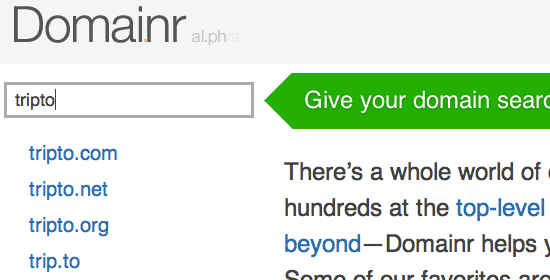
Nowadays, it’s difficult to find a domain name that end with the popular .com, .net, and .org TLD’s. Domainr is an innovative web tool that helps you explore other TLD’s that have made popular websites like last.fm and del.icio.us stand out from the crowd. Of course, searches will also include popular top-level domains that are available.
2. Dot-o-mator

Dot-o-mator is a web tool that suggests site names based on prefixes and suffixes that you’ve entered (keywords). Alternatively, you can use a category of prefixes (like "Tech" or "Games") and suffixes (like "Hardware" or "Web 2.0 words") to generate suggested site names for you. It’s a helpful tool for, at the very least, obtaining inspiration for a site name.
They also have a fun tool called Web 2.0 Domain Name Generator that generates "Web 2.0" site names like "Yakidoo" or "Zoompulse".
3. BustAName

BustAName is a robust and feature-packed domain finder that uses linguistic data to help you search domains. BustAName allows you to save and manage/organize your searches for later use. It has a "List of Words" feature that advise you of similar words to your search - which you can then organize inside folders.
Available domains that are returned can be sorted in a number of ways such as "by quality (readability)" or "by length" for easier viewing. Though the web tool is very intuitive, the creators have a video tutorial on how to utilize BustAName.
4. Domain Tools
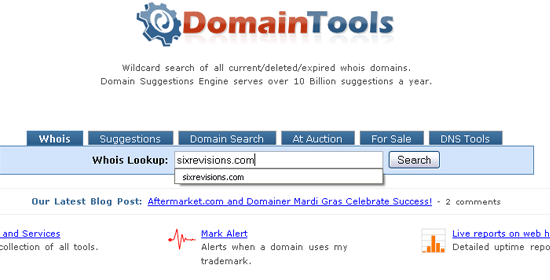
Domain Tools is a set of domain name search engines that will help you uncover relevant information about certain domain names. They have a "Whois" search that reveals records about the party who registered the domain, a "Suggestions" search to help you find similar domain names, a "Domain Search" which shows you what TLDs of a domain name are available, and domain names that are "For Sale" or "At Auction".
5. Domize
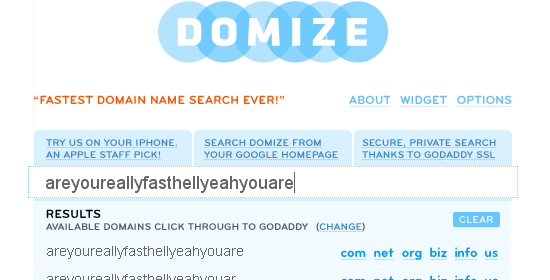
Domize is a fast, Ajax-based search engine that you can use to rapidly check the availability of domains. Domize has a widget that you can install on your website to provide a domain search engine to your visitors. Domize also has an iPhone app – because domain name inspiration can hit you at anytime (hopefully you have your iPhone with you when it happens).
6. squurl
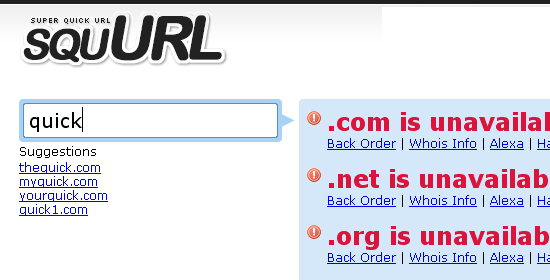
squurl is another fast Ajax-based domain search engine. It has a "Suggestions" feature to help you discover similar domains to the ones you’ve typed.
7. DomainsBot

DomainsBot is a domain search engine that has an "Advanced" search feature so that you can conduct a more customized and refined search. For example, you can set the maximum domain character length to eliminate lengthy domain names from the results or exclude domain results that have a hyphen (-).
8. dnScoop

dnScoop tries to estimate the value of a particular domain based on several statistics such as site traffic, links pointing to the domain, and other factors. This will help you gain some insight on the value of a particular domain name in case the name you really want is "for sale" and you want to see if the asking price is fair, or to make an offer to a site owner that owns the domain you really want.
9. StuckDomains
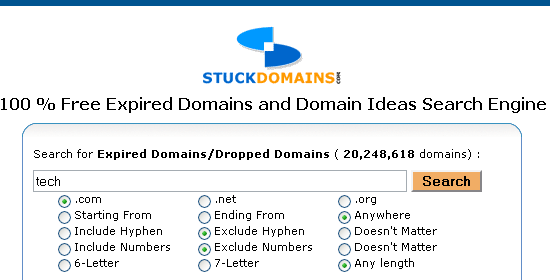
StuckDomains is a database of expired domain names that previous owners have not renewed. This can be an opportunity to find a domain name that doesn’t involve odd names like "fujiyakuku.com".
10. Nameboy

Nameboy is a popular domain name generator. This straightforward web tool asks for a "Primary Word" and "Secondary Word" that describe the topic of your website, and based on your input, it suggests possible domain names.
For example, typing in "web" as the Primary Word and "superman" as the Secondary Word returned results such as webhero, supeweb and supermanweb. There’s a "Rhyme" option that tries to suggest domain names that rhyme with the search phrases, but the feature didn’t seem to work on the above example.
11. dyyo.com
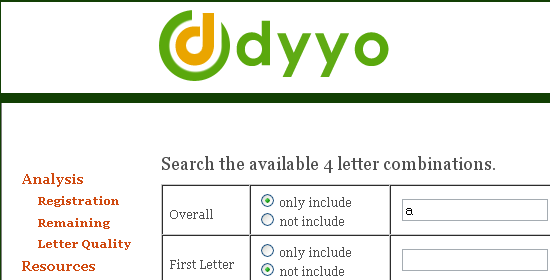
It’s common practice to keep domain names as short as possible so that it can be quickly typed and also so that they’re easier to remember. dyyo.com specializes in helping you find 4-letter domain names to keep your URLs terse.
12. Ajax Whois
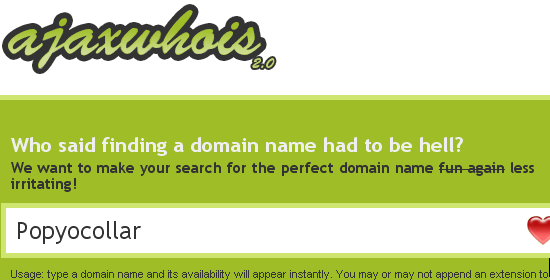
Ajax Whois is a simple Ajax-based domain search that makes domain-name-hunting effortless and rapid. To make your searches even faster, they have a set of useful keyboard shortcuts to satisfy the power user in you.
The .tel domain names will be available from this afternoon. They differ from other website addresses because they are meant to host individual entries that together will make up a vast virtual directory.
Companies and individuals are being encouraged to list their phone numbers, websites, postal addresses, e-mail addresses and even their Facebook details on their .tel page.
“.tel is your place on the internet, which will act like a switchboard.” Kash Mahdavi, the chief executive of Telnic, the London-based company that runs the .tel registry, told the Times.
“You can say, ‘Here are my Facebook details, here is my mobile number, and people will always be able to find you’.”
The sites are expected to be popular with businesses. But because the majority of the addresses will be sold on a first-come, first-served basis, meaning a local bistro is just as likely as a large chain to secure the address for itself.
Today, in the “landrush” part of the auction, all other names will be made available for purchase. Each costs about $300 (£210) for the first three years and $20 a year after that. They will become active at the end of this month.
Naming is linguistic design, and a good domain name is an important part of the overall design of a website. A name plays a prominent role when people discover, remember, think about, talk about, search for, or navigate to a website. It establishes a theme for the branding of a website before people even visit it for the first time.
Coming up with a good domain name requires a combination of strategy, imagination and good linguistic design practice.
You’ll find some basic pieces of advice all over the Web, and it’s worth mentioning those right away. Ideally, your domain name should be:
- Short
- Catchy and memorable,
- Easy to pronounce,
- Easy to spell,
- Not too similar to competing domain names,
- Not a violation of someone else’s trademark.
These are all good rules of thumb. But they lack specifics. These are really criteria to use to evaluate ideas for names after you’ve thought of them. To come up with a name in the first place, you need to know what type of name is best for you. And before you can answer that question, you have to answer two others: one about your resources, and the other about your Web strategy.
Domain names provide the identity of a website. Choosing a domain name for your site can be difficult. You will want to choose something memorable, something that reflects your products and services, and something that is SEO friendly.
Because there have been millions of people who set to the task of choosing a url before you did, finding SEO friendly domain names that haven't already been taken can be a bit tricky. This is why it is a good idea to work on naming your website and choosing a domain name at the same time.
Here are a few other things to consider when choosing a URL (domain name) for your website:
* Put your branding in your domain name.
One of the reasons that choosing a domain name is so difficult is the idea of branding. Your website name and your domain name are your brand, and they should be one in the same. Branding can be tricky because you are, in essence, establishing your website identity. You need a name that reflects what you will be promoting. For example, an informational website about debt will be best served with domain names that somehow mention debt.
Real life examples of domains that were chosen to reflect branding are Amazon.com and Bookfinder.com.
* Consider the length of your domain name.
If you have already started researching domain names, then you have probably already heard several arguments about the benefits of choosing a short domain name vs. a long domain name. Both arguments have their points. A long domain name is generally more SEO friendly and can better describe your products. A short domain name, on the other hand is easier to remember and easier to type into a browser.
When choosing a domain name, you can use up to 67 characters. This means that you don't have to settle for short, obscure, or abbreviated domain names. At the same time, it is unwise to use anything close to 67 characters. It simply leaves too much room for error when someone is typing in the URL. A ridiculously long domain name will also make it difficult for people to share your website through word of mouth.
* Using hyphens in domain names.
Sometimes, when Webmasters can't get the domain names they want, they simply add hyphens. For example, if discountbooks.com was taken, one could simply add a hyphen and buy the domain name discount-books.com. There are advantages and disadvantages to choosing a url with a hyphen. The advantage is that search engines can better distinguish your keywords, making your website a little more SEO friendly. The disadvantage is that it is very easy to forget a hyphen when typing and you run the risk of sending your site’s visitors to your competitor.
You should also consider if you are getting yourself into a hornet's nest situation with trademarked business names, so be careful.
* Top level domains.
When choosing a domain name, you also have to decide what you want your top level domain (your domain name extension) to be. While almost everyone wants to be a .com, that option may not be available to you. The good news is that there is nothing necessarily wrong with choosing other domain names that end in .net, .org, .us, or even .biz.
Submitting Content to About Home Business
Have an idea, tip or story you would like to share here? Your content is welcome. Click for instructions for submitting content to About Home Business.
You can paste text content into the text box area provided on that page. If you are submitting an attachment, use the email link on that page and be sure to copy and paste the disclaimer text contained on the page into the body of your email message. Attachments or inline articles sent via email without the disclaimer text cannot be considered. If you are submitting a PDF version of your article you should convert the content to text first and then paste it into the text box instead of sending the content only in its PDF format.
While I won't promise I'll publish all of the content I receive, I'll certainly consider it. If your content is chosen for publication I'll let you know when you can expect to see it on About Home Business.
Difficulty: Average
Time Required: 3 days
Here's How:
1. Pick a good domain name. Shorter is better. Memorable is better. Keywords in the domain name is good, but may or may not be appropriate, depending on your business.
2. Find a cheap domain registrar. Network Solutions still charges something like $35 a year for basically the same service others provide for less than $10. I have used GoDaddy for all my personal and business sites since 2001 and have been very happy with them. As of 2006, they are the #1 registrar for .COM, .NET, .ORG, .INFO and .BIZ domains. I'll use them as the example in the following steps.
3. Visit GoDaddy.com and see if your desired domain name is available. If it is, scroll down and hit the "Continue" button. Otherwise, pick from one of the available suggested names, or go back to the drawing board (Step 1).
4. Create an account if you don't already have one. Enter and/or update the registration information. Choose the length of registration you want, then keep clicking on "Continue to checkout" to skip all the offers for additional services.
5. Within a few minutes, the domain will be set up. If you already have your hosting arranged, on GoDaddy, from the menu choose Domains/My Domains. Click on the checkbox next to the new domain name then click on Nameservers at the top of the list.
6. Select the "Custom Nameservers" tab and enter the nameservers for your host. Two are generally required and most often they are NS1.NameOfYourHostingCompany.com and NS2.NameOfYourHostingCompany.com, but you should confirm before entering them.
7. Find an inexpensive web host. The host I recommended for about five years finally stopped their $10 a year service, but there are a number of other companies that offer $1 a month web hosting. This is pretty no-frills, and there's not typically an uptime guarantee, but if you're just starting out on a budget, you can get a year's worth of hosting for what other places charge monthly. Just search Google for $1 web hosting and you'll find plenty of results. You'll usually have to prepay the year, but at that price, who cares?
8. Find an inexpensive web host. The host I recommended for about five years finally stopped their $10 a year service, but there are a number of other companies that offer $1 a month web hosting. This is pretty no-frills, and there's not typically an uptime guarantee, but if you're just starting out on a budget, you can get a year's worth of hosting for what other places charge monthly. Just search Google for $1 web hosting and you'll find plenty of results.
9. Visit the site and sign up. You will provide your new domain name during the registration process. Be sure to jot down the nameservers (there should be at least two) and the FTP login information they provide.
10. Create a website using the HTML editor of your choice. If you don't already have FrontPage or FrontPage Express, there are many free HTML editors (for Mac) to choose from.
11. Upload your site, and "voilá" - you're done!
Tips:
1. You really don't save much money registering your domain for two years (many domain registrars will automatically set it for this term unless you specify otherwise) over doing it a year at a time. To make sure you don't lose your domain because you forgot to pay it, you can choose to automatically renew, and they'll just re-bill your credit card every year.
2. Realize that discount hosting plans are usually fairly inflexible. Make sure you know what features you're actually getting and that it will meet your needs. For example, do you need an actual e-mail account? Or can you just have e-mail forwarding set up to go to your existing GMail, Yahoo, Hotmail or AOL account?
3. You can do a lot with PHP and a database, which even most cheap hosting plans include. Check out the PHP scripts at HotScripts.com for shopping carts, portals, content managements systems - everything you'd probably ever want.
4. Don't expect a lot of support for $1 a month hosting. You'll usually have to submit support questions via e-mail or a discussion forum -- you probably won't be able to get anyone on the phone. If that's an issue for you, you should consider a mid-priced hosting service.
What You Need:
* A good domain name
* Your credit card handy
* An e-mail account
Internet Domain Names
A domain name is a string used to name Web sites and other servers on computer networks. On the Internet, these strings are managed by the Domain Name System (DNS). The DNS uses a system of multi-level strings separated by dots ('.') to organize domain names. For example, the Web site
compnetworking.about.com
uses three levels of naming. The levels are listed in order of lowest to highest when reading from left to right. In this example, the first substring ('compnetworking') represents one specific Web site or sub-domain. Then, the second substring ('about') represents a organizational domain that points to a Web site but also contains numerous other sub-sites (sub-domains). Finally, the third substring ('.com') represents a top level domain (TLD) that encompasses numerous organizations worldwide.
TLDs - Common Domain Extensions
.com is the most commonly used top-level domain extension on the Internet. Many others exist, however. These other six TLDs were part of the original Internet specifications for domain extensions:
* .edu
* .gov
* .int
* .mil
* .net
* .org
In recent years, many new TLDs have been deployed on the Internet. Some of these are intended for broad use worldwide, while others are designed to serve special interest groups. Though not as popular as the original TLDs listed above, you may also encounter some of these newer domain extensions when browsing the Web:
* .biz
* .info
* .jobs
* .mobi
* .name
* .tel
The ICANN organization ultimately oversees the process of managing Internet domains including new TLD extensions.
About Country Domain Extensions
Besides the generic TLDs listed above, the Internet also maintains domain extensions for each country to help organize Web sites within each nation. These extensions are named according to worldwide standard two-letter country codes similar to those used by the postal system. Examples of country code TLDs include:
* .br (Brazil)
* .ca (Canada)
* .cn (mainland China)
* .fr (France)
* .in (India)
* .jp (Japan)
* .ru (Russian Federation)
* Ensure each workgroup and domain name is no longer than 15 characters.
* Ensure no workgroup or domain name contains spaces. Windows ME and earlier versions of Windows do not support workgroups or domains with spaces in their name.
* Whenever possible, ensure all computers on the LAN use the same workgroup/domain name. Using common workgroups/domains makes it easier to browse the network and avoids some security complications when sharing files. Note that the default workgroup name in Windows XP is "MSHOME" but in older versions of Windows is "WORKGROUP".
* Ensure the name of the workgroup/domain is different from the name of any computer on that network.
* Avoid special characters in workgroup and domain names. Whenever possible, do not use any of the characters when naming Windows workgroups and domains: / \ * , . " @
* For simplicity, avoid using lower-case letters in workgroup or domain names.
* The workgroup name need not match the network name (SSID) on a Wi-Fi LAN.
To set or change workgroup/domain names in Windows XP, right-click on My Computer or open the System icon in Control Panel, then choose the Computer Name tab and finally, click the Change... button to access the workgroup/domain name fields.
To set or change workgroup/domain names in Windows 2000, open the System icon in Control Panel and choose the Network Identification tab, then click the Properties button.
To set or change workgroup/domain names in older versions of Windows, open the Network icon in Control Panel and choose the Identification tab.
Over the years, scientists have developed several systems for the classification of organisms. From the late 1960's, organisms had been classified according to a Five Kingdom system.
This classification system model was based on principles developed by Swedish scientist Carolus Linnaeus, whose hierarchical system groups organisms based on common physical characteristics.
The Three Domain System
As scientists learn more about organisms, classification systems change. Genetic sequencing has given researchers a whole new way of analyzing relationships between organisms.
The current system, the Three Domain System, groups organisms primarily based on differences in ribosomal RNA structure. Ribosomal RNA is a molecular building block for ribosomes.
Under this system, organisms are classified into three domains and six kingdoms. The domains are Archaea, Bacteria, and Eukarya. The kingdoms are Archaebacteria (ancient bacteria), Eubacteria (true bacteria), Protista, Fungi, Plantae, and Animalia
The Archaea and Bacteria domains contain prokaryotic organisms. These are organisms that do not have a membrane bound nucleus.
Eubacteria are classified under the Bacteria domain and archaebacteria are classified as Archaeans.
The Eukarya domain includes eukaryotes, or organisms that have a membrane bound nucleus. This domain is further subdivided into the kingdoms Protista, Fungi, Plantae, and Animalia.
Comparison of Classification Systems
Five Kingdom System
Kingdoms: Monera, Protista, Fungi, Plantae, and Animalia.
Three Domain System
Archaea Domain
o Archaebacteria Kingdom
Bacteria Domain
o Eubacteria Kingdom
Eukarya Domain
o Protista Kingdom
o Fungi Kingdom
o Plantae Kingdom
o Animalia Kingdom
As we have seen, systems for classifying organisms change with new discoveries made over time. The earliest systems recognized only two kingdoms (plant and animal).
The current Three Domain System is the best organizational system we have now, but as new information is gained, a different system for classifying organisms may later be developed.
Cheapest, reputable domain name registrars. Some of the firms listed here only do domain registration, but most also offer Web hosting and other services.
The prices listed here are for a standard new customer for one .com domain for one year.
You can usually get discounts when you register domains for more than one year. Non .com top-level domains (eg., .net, .org, .mobi, .biz) are sometimes offered for registration at a lower price, especially if you just registered the .com version.
$5.95 per year.
Bonus: Free private registration.
2. Hostway
$7.95 per year.
3. 1&1
$6.99 per year.
Full service Web firm that offers Web hosting (shared, VPS, dedicated), domain name registration, and more.
4. GoDaddy
$9.99 per year.
If you purchase a non-domain product from them (eg., hosting, SSL certificate), you can register domains for $1.99.
5. Yahoo Domains
$9.95 for one year.
If you host with them, you get one free domain name registration.
6. estdomains
$7.19 per year.
7. Namecheap
$9.29 per year.
How to Choose a Domain Name
A domain name is any combination of letters and numbers followed by .com, .net, .tv, .cc, .biz or other top-level domain designations. A domain name is the kernel of the URL, or Uniform Resource Locator, which takes the form of http://www.about.com. Within this URL, about.com is the domain name.
The majority of companies use .com or .net, but don't let that limit you. If you sell furniture appropriate for a television room, use .tv. If you want a more casual-sounding image, try .biz. Keep in mind that some domain names (such as .edu and .mil) are restricted to specific kinds of organizations and that some of the newer top-level domains (such as .cc) aren't widely familiar.
There are tens of millions of active domain names, which means that it is more difficult than ever to find an appropriate domain name, because your first choice may already be registered by someone else. Fortunately, there are ways that you can make this situation work to your advantage if you can't get yourcompanyname.com.
* Think conceptually. For example, irrigation company Aqua-Tech registered the domain name watermylawn.com. If you offer a specific experience or fulfill a specific need, turn it into an imaginative domain name.
* Add words. The Spencer Company, an office furniture and accessories business, owns the domain buyspencer.com. Adding "buy" or "try" before your domain name can make it more unique and catchy, and someone might not have snapped it up already.
If you need further help, try a domain name suggestion service such as the one offered by VeriSign. You can feed such a service keywords (including your business name and other concepts important to your business), and it'll automatically offer you domain name suggestions.
How to Register a Domain Name
In the early days of the Web, individuals and businesses registered their domain names with the registry service Network Solutions, then transferred the hosting rights to a hosting provider. Fortunately, there's no need to deal with two separate parties when registering and hosting your domain name because Network Solutions is no longer the only accredited registrar.
If you go to almost any Web hosting company - such as GoDaddy, SiteGround or Yahoo! Web Hosting - you'll notice an embedded search box somewhere on the main page that will let you see if the domain name you want is available. If it is, the hosting company can register it for you directly. The hosting company will notify you when the domain name is active, and warn you when it is time to renew.
In addition to the well-known hosting companies, hundreds of others can act as registrants and hosts for your domain name. You can use one of these companies to register a domain name and host the domain on your own server(s). However, few small businesses can afford the costs of hosting their own Web presence, which is almost always handled by a hosting specialist on your behalf.
Note that although hundreds of companies are legally qualified to register a domain name on your behalf, not all are equally reliable. Be certain to research your registration/hosting company of choice before committing to it.
How to Renew Your Domain Name
It may seem that renewing your domain name is trivial. It isn't. If you fail to renew your domain name, it can be taken over by someone else. There is nothing more frustrating than watching an Internet squatter hijack your domain name just because you were too distracted to renew it.
Fortunately, it's easy to prevent this kind of problem by instructing your hosting company to automatically renew your domain name every year. Even so, be aware of when your domain name registration expires, and remain extra vigilant at this time.
If your domain name is also a company trademark or otherwise protected intellectual property, you'll be less susceptible to domain name hijacking.
.COM or Nothing
Many people believe that the .com domain is the only domain worth purchasing because that's the one that most people assume when typing in domains. While it's true that .com domains are very popular, there are lots of businesses which use other top-level domains without a problem.
What you have to think about is how your customers are going to access your site. If they are going to type in your company name into the URL bar and hit enter, then getting the .com domain is a must. But if you can brand your site with the .net or .us and get people used to using that, it won't matter. Another solution is to use the TLD as part of your entire corporate name. The well-known social bookmarking site Delicious does this quite well with their domain: http://del.icio.us/.
.ORG and .NET Domains
After .com, the .net and .org TLDs are easily the most popular. There used to be a distinction that .org domains were for non-profits and .net domains were for Internet companies. But as there is no regulation, that quickly went out the window. And these days, anyone can get a .org or .net domain name.
If I can't get my perfect domain name as .com but I could get it as .net or .org, I would probably buy one of those. The only real drawback to these TLDs is that some registrars charge extra for them.
The Perfect Domain Supercedes the TLD
This school of thought says that if you have the perfect domain name, one that is memorable, easy to spell, and catchy, it won't matter what TLD it has. This is true if you have a company name that is already well established and you don't want to change it to accomodate a website domain. Then, becoming "mycompanyname.biz" is preferable to some other domain name even though it's on a less popular TLD.
Country Designation TLDs
Country designations are TLDs that are supposed to indicate products or services available in that country. These are TLDs like:
* .us - United States
* .co.uk - United Kingdom .com address
* .de - Germany
Some country domains can only be registered by businesses that operate in those countries, while others are available freely to anyone willing to pay the domain fee. For example .tv is actually a country TLD, but many television stations have bought domains using it.
Keep in mind that even if you can use a country TLD while not operating there, it might not be a good idea. Some people might get the idea that your business is only available there, when in fact it's global.
The Strange TLDs - .Biz, .Info, Etc.
There have been lots of TLDs suggested and implemented for various reasons. The .biz domain is for businesses while .info should be to provide information about something. However, there is no regulation on how they are used. These domains can be very tempting as often they are available when the more popular .com, .net, or .org are already taken. But some people are nervous of these new domains. I've been told that "spammers lurk on .biz domains".
I'm not saying that spammers really do use .biz domains, just that there is a general distrust of these domains. I wouldn't rely on a domain name with a .biz TLD unless I had no other choice. But this attitude is slowly changing. In a few years, these domains may be perefectly reasonable.
1. NetFirms
$4.95 for one-year .com registration
Sponsored Links
Create Email CampaignsCreate your own or use templates Easy-to-use. 500 emails free!www.VerticalResponse.com
Domains for Rs 250/-Cheapest Indian Domain Names Linux & Windows Hosting from Rs 100www.indialinks.com/domains
Affiliate Make MoneySteps To Start Your Online Business Cash Flow Business Online Join Now!www.HYaffiliates.com
2. Yahoo
$4.98 for one-year .com registration
3. EV1Servers
$5.99 for one-year .com registration
4. Hostway
$6.95 for one-year .com registration
5. Stargate
$6.95 for one-year .com registration
6. Interland
$7.95 for one-year .com registration
7. Web.com
$7.95 for one-year .com registration
8. AIT Domains
$7.99 for one-year .com registration
9. Go Daddy
$8.95 for one-year .com registration
10. RegisterFly
$9.99 for one-year .com registration
1. Choose a domain name for your business AND for your product.
Yes, that’s right. Multiple domain names. For example, if your business is ABC Corporation and your product is called Maximize Your Sales, then get a domain name called www.ABCCorporation.com and www.MaximizeYourSales.com. You can have both of these domain names pointing to different pages of your web site. This way, customers who only know you by your product name can find you easily by typing in the NameOfYourProduct.com, and those who know you by your corporate name can find you easily by typing YourCorporation.com. (Hint: If you are an individual with a small business, you should register your personal name also).
2. Get domain names with dashes in them.
In the previous example, we used the company and product domain names. Now, go out and purchase www.ABC-corporation.com and www.Maximize-Your-Sales.com.
Why should you do this? Two reasons, really: The first is aesthetic appeal. Wouldn’t you agree that it’s easier to read the long domain names with the dashes in them? However, it is much easier to type a name into your browser without the dashes, and that makes it easier on your customers, which is why you purchased the domain name without the dashes.
Additionally, domain names with dashes sometimes rank a bit higher in the search engines. A higher ranking in the search engines will drive more customers to your web site. Search engine algorithms are ever changing, but buying multiple domains and pointing each one of them to a specific, product-related page on your main site can ultimately help you make more sales in the future. Be sure not to point multiple domains at the same page, though -- that will get you dropped from most search engines.
3. Purchase domains that are similar in spelling to yours.
Every day, someone misspells a word. Inevitably, they will still land on someone's web page. Why not yours? Using the example above, you might want to purchase www.abccorperation.com and www.maximiseyoursales.com just to be safe. It's easy to reroute these names to your main web page after you own them.
4. Use a top keyword in your domain name.
Let’s use another example to illustrate: Suppose you are selling garden tools. Not just any garden tools, you sell low cost, high quality garden tools. The name of your company is Garden Tool World. Using the tips above, you will purchase the domain names for your company. But what about your product?
The key here is to look for names for your product domain that people will be searching for. When a potential customer goes to a search engine, will they look for “low cost high quality garden tools”? Or will they look for “Cheap Garden Tools”? With a little research, you can find out what people are looking for.
I use two tools to see what people are looking for on the internet: WordTracker and Overture’s Inventory. Simply type in the word or phrase you are looking for and you will see instantly which phrases are most popular. So if people are looking for “Cheap Garden Tools”, then your domain name might be: www.cheapgardentools.com.
Choosing a domain name is an important part of the overall marketing process and should not be taken lightly. Make sure your domain name represents your company, product and image, and you'll be setting a great foundation for future sales.